The short answer
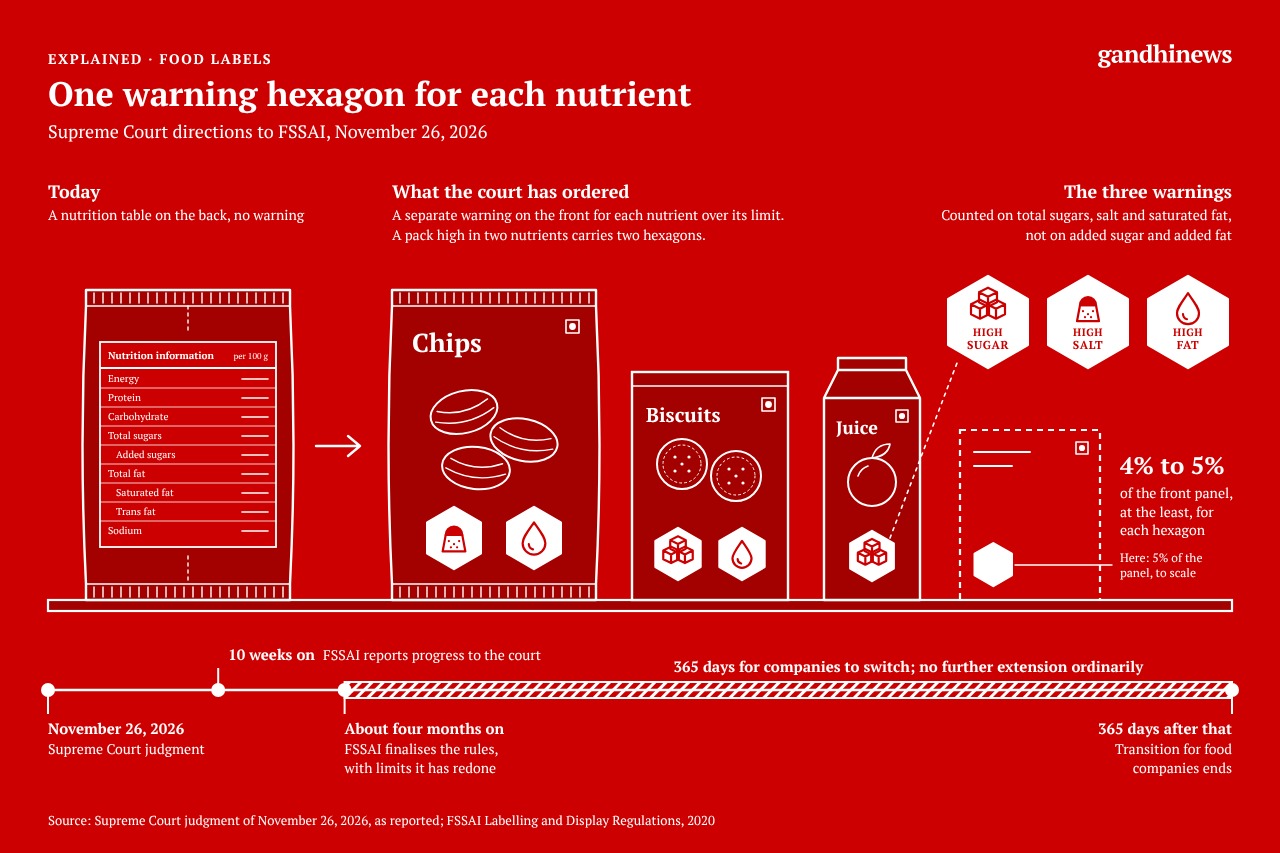
On November 26, 2026, the Supreme Court told the food regulator FSSAI to put a separate red hexagon warning, reading HIGH SUGAR, HIGH SALT or HIGH FAT, on the front of packaged foods that cross set limits. The warnings must cover total sugars and saturated fat rather than the 'added' sugar and fat FSSAI had proposed, and FSSAI must redo the limits so they are neither too strict nor too loose. FSSAI's own plan gives about four months to finalise the rules and a year for companies to comply, and the court has asked for a progress report in ten weeks.
What has the Supreme Court ordered?
A separate red warning on the front of packaged food for each nutrient a product has too much of. On November 26, 2026, a bench of Justices J B Pardiwala and K Vinod Chandran ruled on a public interest petition by 3S and Our Health Society, and directed the Union government and the Food Safety and Standards Authority of India (FSSAI) to bring in front-of-pack warnings for foods high in sugar, salt or fat.
The petitioners had asked for warning labels in place of the star rating that FSSAI floated in 2022. The court sided with warnings, and in the 131-page judgment, written by Justice Pardiwala, said the process had dragged: “Inertia plagued the whole process.”
What will the label look like?
A red hexagon with a picture of the nutrient and the words HIGH SUGAR, HIGH SALT or HIGH FAT. FSSAI had proposed one combined hexagon listing every nutrient over its limit. The court rejected that: a product high in both sugar and fat will carry two separate hexagons, each with its own pictogram.
Each hexagon is to cover not less than 4% to 5% of the front panel, in a font the court described as “prominent, conspicuous and readily legible”. It also turned down two alternatives FSSAI had offered along the way, bolder type on the back of the pack and daily intake figures on the front, as not being a real front-of-pack warning at all.
What does a food packet have to show today?
A nutrition table, usually on the back, and no warning. The Food Safety and Standards (Labelling and Display) Regulations, 2020 require energy, protein, carbohydrate, total and added sugars, total, saturated and trans fat, and sodium, per 100 g or 100 ml. They also require the per-serve share of a daily allowance, worked out against 2,000 kcal, 67 g of total fat, 22 g of saturated fat, 2 g of trans fat, 50 g of added sugar and 2,000 mg of sodium (5 g of salt) for an average adult.
The same regulations define the “front of pack” as the part of the package “that faces forward” and “is typically the first thing a consumer will see”. They put the brand name and the veg or non-veg mark there, but no health warning. That is the gap the court has now told FSSAI to fill. The court’s own line for why it matters: “The label is the only witness at the point of sale.”
What the 2020 rules measure against
- 2,000 kcaldaily energy for an average adult
- 50 gadded sugar a day
- 22 gsaturated fat a day
- 5 gsalt (2,000 mg sodium) a day
Why total sugar instead of added sugar?
Because a laboratory cannot tell added sugar from natural sugar in a finished product. FSSAI had proposed to trigger the warnings on “added sugar” and “added fat”. The court directed that the warnings treat total sugars and saturated fat as the nutrients of concern, alongside salt, and noted that “added fat” is not used as a labelling measure anywhere. Total sugars and saturated fat were also the measures on which an FSSAI stakeholder consultation had reached agreement in 2021.
Where will the limits be set?
The court did not set numbers; it told FSSAI to redo them. FSSAI’s latest proposal tied its thresholds to the Dietary Guidelines for Indians, 2024, from the ICMR-National Institute of Nutrition, and would trigger a warning when any one nutrient crossed its limit. An earlier version would have warned only when two or more nutrients were high, which the petitioners called scientifically unjustified.
The court asked for limits that are “neither too low nor too high”, to be tightened over time. Too low, and almost everything carries a warning: one study before the court found that 94.1% of 44,109 packaged-food records would trip at least one warning under the values on record, which the judges said would cause “label fatigue”. Too high, and “most products” would “escape the label altogether”.
How long do companies have?
About four months for the rules and a year after that, with no extensions as a rule. The court held FSSAI to its own proposed timeline of about four months to finalise the draft regulations, followed by a 365-day transition for food businesses, who may switch earlier. “No further extension shall ordinarily be granted,” the court said, and it asked FSSAI to watch for companies stockpiling unlabelled packs. FSSAI must file an affidavit on progress after ten weeks, when the case returns.
From star ratings to warnings
- 2020Labelling and Display Regulations notified, nutrition table required
- July 1, 2022Revised nutrition-table provisions take effect
- 2022FSSAI floats a star-rating front label; over 14,000 comments filed
- November 26, 2026Supreme Court orders separate warning hexagons
- About 10 weeks onFSSAI progress affidavit due
What else did the court say?
It turned to schools and to multinational brands. It directed the Union government to enforce the 2020 regulations on safe food and balanced diets for children in schools “strictly, both in letter and spirit”, and to add practical nutrition literacy to teaching. On reports that global companies sell healthier versions abroad than in India, it said: “If true, such double standards are deeply troubling.”
Who is worried?
Small snack makers and the shops that sell them. The All India Consumer Products Distributors Federation, which says it speaks for more than four lakh distributors, welcomed a “scientifically balanced and practical” framework but warned that bhujia, namkeen and snack makers lack the money multinationals have to change recipes, and asked FSSAI for rules on clearing old stock. No response from FSSAI or the health ministry had been made public at the time of writing.
The documents
- Food Safety and Standards (Labelling and Display) Regulations, 2020, compendium version II (December 29, 2021)Food Safety and Standards Authority of India, January 4, 2022