Key points
- Delhi's average AQI was 319 at 6:30 am on Thursday, in the very poor band, against 299 on Wednesday.
- IIT Delhi read 413, the only station quoted in the severe band, and 36 of 58 stations were above 300.
- The IMD sees no rain through November 15, and GRAP Stage III has been in force since November 6.
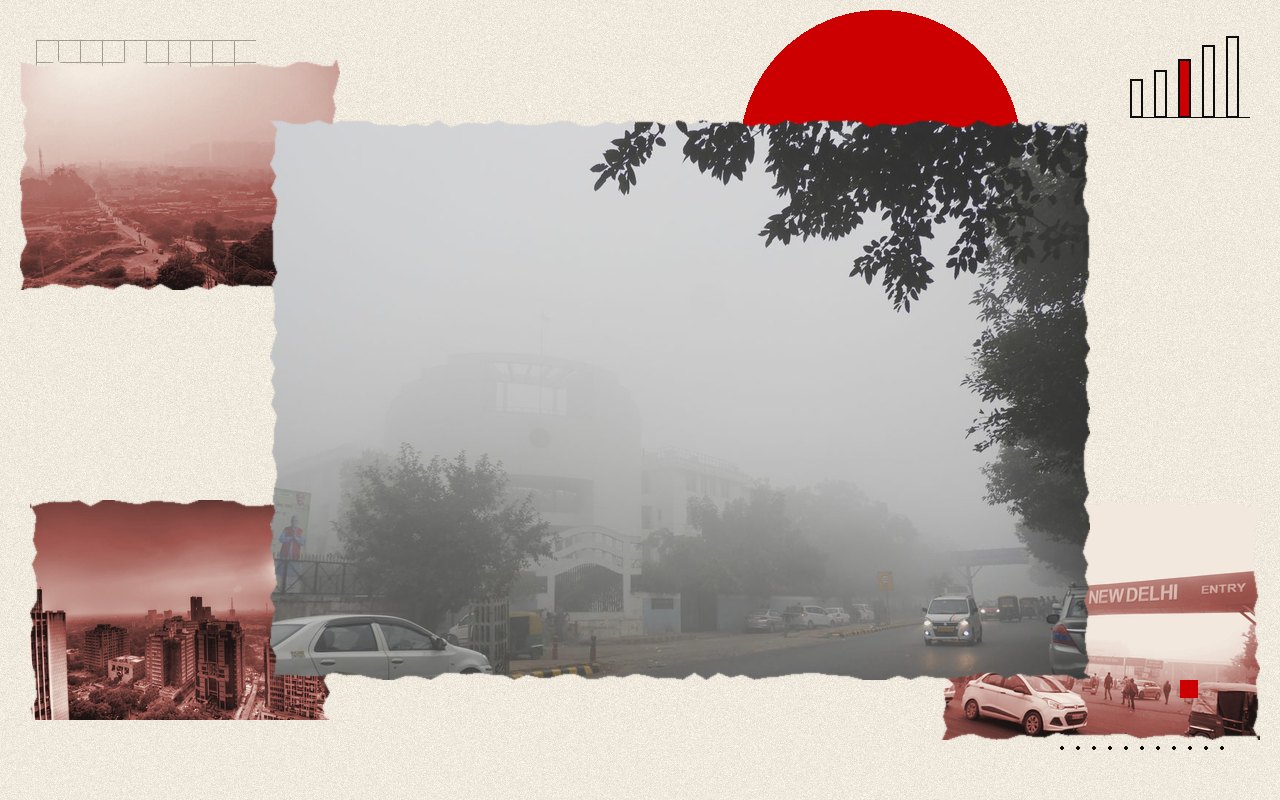
Delhi’s air quality turned worse again on Thursday morning, with the city’s average AQI at 319 at 6:30 am, in the very poor band, up from 299 on Wednesday. At IIT Delhi the reading was 413, in the severe band, the highest of the stations quoted.
Of the city’s 58 monitoring stations, 36 were above 300 at 6:30 am. The wider pattern is that the relief of the past two days has gone. Delhi had been averaging in the high 360s and 370s over the Diwali weekend before easing to 299 on Wednesday, and the early-morning figures now show smog settling in again over the capital.
What the stations show
Beyond IIT Delhi’s 413, Jaffarpur and ITO were both at 394, within a few points of the severe mark of 400. Pusa Road read 382, Burari Crossing 378, Dwarka and JNU 376 each and Mathura Road 363. Earlier in the night the picture was much the same: the average stood at 313 at 1 am, and readings reported from CAQM and IITM monitoring that night had Burari at 375, R K Puram at 388, Jahangirpuri at 334 and IIT Delhi at 405.
The Air Quality Index bands matter for what residents are asked to do. Readings of 301 to 400 are “very poor” and above 400 is “severe”. Part of the post-Diwali spike has been put down to stubble burning in neighbouring states, though how much of it reaches Delhi changes from day to day.
Curbs already in force
The Commission for Air Quality Management ordered GRAP Stage III across Delhi-NCR on November 6 with immediate effect, when the average AQI was 382. Under it, BS-III petrol and BS-IV diesel four-wheelers are barred in Delhi and the selected NCR districts, older light and medium goods vehicles face tighter rules, and diesel commercial vehicles registered outside Delhi are kept out of the city. Dust-heavy work such as construction, demolition and excavation is suspended, with essential projects allowed to continue under dust controls, and stone crushers and mining are shut or limited.
Primary classes up to Class 5 are on hybrid learning, offices are advised to allow work from home, and residents are urged to use the metro, buses or electric vehicles. The commission’s aim in invoking Stage III early was to act before the index crossed the severe threshold of 400 and to prevent a move to Stage IV. Our earlier reports on the Stage III order and the Monday readings trace how the average held in the high 300s through Diwali week.
No rain in sight
The India Meteorological Department forecasts no rain in Delhi through November 15. Maximum temperatures are expected at 27 to 30 degrees Celsius and minimums at 14 to 17 degrees, with Thursday at 27 to 29 and 15 to 17. A western disturbance is approaching, but it is not expected to change temperatures meaningfully.
IMD Director General Mrutyunjay Mohapatra has said Delhi may see partly cloudy skies on November 12 and 13 but that rain is unlikely. The clouds that come with the disturbance are medium and high-level, not the convective clouds that bring rain, so any rainfall would be small. Such cloud cover can sometimes hold pollution closer to the ground rather than clear it.
That has put cloud seeding back in the conversation. The Delhi government and IIT Kanpur are exploring the technique, which releases substances such as silver iodide into suitable clouds. Two trial runs were held near Delhi airport in October, and further operations are being considered after Diwali and Chhath. Mohapatra’s caution about the type of cloud on offer suggests the expected weather would not be a good fit.
Why it matters
For Delhi residents the practical effect is another stretch of mornings in which the air carries a health warning, on top of a week of curbs on traffic, building work and school routines. The restrictions fall on construction workers, goods transporters and parents of young children first, and they stay until the commission reviews them. The political argument over the quality of the data has also not gone away: Congress president Mallikarjun Kharge said on November 10 that PM2.5 readings were missing from 36 of Delhi’s 59 stations at the season’s peak, a charge we covered in our report on Diwali night data.
What happens next
The air is expected to stay in the very poor to severe range while the dry spell lasts, to at least November 15. The CAQM will decide whether Stage III continues or moves to Stage IV if the index climbs past the severe line, and the next daily bulletin from the Central Pollution Control Board, due at 4 pm, will give the 24-hour average for Thursday. Any further cloud seeding trial would depend on suitable clouds, which the IMD does not expect this week.