EconomyPolicy
Cabinet clears ₹14,500 crore to build 92 GWh of energy storage and ₹2,814 crore for lithium, nickel plants
The viability gap funding scheme aims to add storage equal to 170% of India's current grid-scale capacity, while a separate subsidy will back four critical mineral processing plants.
Key points
- The Cabinet approved ₹14,500 crore in viability gap funding for grid-scale energy storage.
- The scheme targets 92 GWh of new storage and about ₹97,600 crore of investment.
- A ₹2,814 crore capex scheme will part-fund two lithium and two nickel processing plants.
The Union Cabinet on Wednesday approved ₹14,500 crore in viability gap funding to help build grid-scale energy storage, a step meant to let India’s power grid absorb far more solar and wind power. At the same meeting, chaired by Prime Minister Narendra Modi, it cleared a separate ₹2,814 crore scheme to set up lithium and nickel processing plants at home.
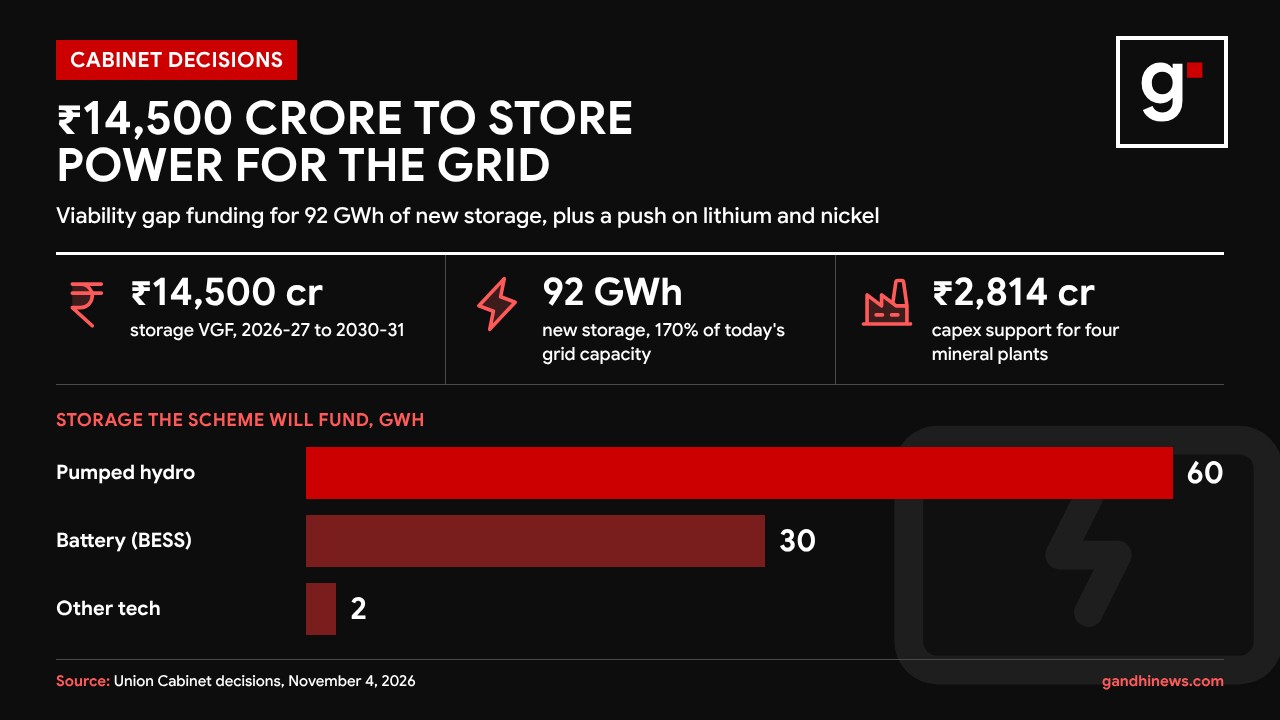
The storage money will be spent between 2026-27 and 2030-31. It is meant to bring in 92 GWh of storage capacity that has not yet been commissioned, equal to 170% of the grid-scale storage the country has today. The government estimates India will need 411 GWh of such storage by 2031-32.
How the storage will be split
Most of the new capacity, 60 GWh, will come from pumped hydro storage, which pumps water uphill when power is cheap and releases it through turbines when demand peaks. Battery energy storage systems will add 30 GWh, and 2 GWh is set aside for other technologies.
Capacity will be handed out through tariff-based competitive bidding. Public and private power distribution companies can get the support for battery and pumped hydro projects, while public and private firms can build the alternative technology projects. The government expects the scheme to draw investment of about ₹97,600 crore.
Battery projects must meet a minimum 40% domestic content requirement. The official statement said the scheme would strengthen “India’s domestic energy storage manufacturing ecosystem” and cut dependence on imports.
Lithium and nickel plants
The second decision, the Capex Support Scheme to Promote Critical Mineral Processing, runs for five years from 2026-27. It will pay a capital subsidy of 30% of eligible investment for four plants: two lithium processing units of at least 30 kilotonnes each and two nickel processing units of at least 50 kilotonnes each.
Support is capped at ₹500 crore for each lithium plant and ₹900 crore for each nickel plant. Bidders will first be screened on technical grounds and then compete on price, with the two seeking the least support for each mineral selected. The money will be released in three instalments tied to milestones.
India still relies heavily on imports for refined, high-purity lithium, nickel and cobalt, the materials that go into electric vehicle and grid batteries, because it has little processing capacity of its own. Together, the two schemes aim to build the battery supply chain from the mine to the grid.