PoliticsCourts
Two-child norm has lost relevance, says Supreme Court, sends 2003 Javed ruling to larger bench
Hearing a former Maharashtra sarpanch disqualified after her third child, the court said India's fertility rate has fallen below replacement level and asked a larger bench to look again at the law it upheld 23 years ago.
Key points
- The Supreme Court said laws penalising more than two children have lost their relevance.
- A two-judge bench referred Javed v State of Haryana (2003) to a larger bench.
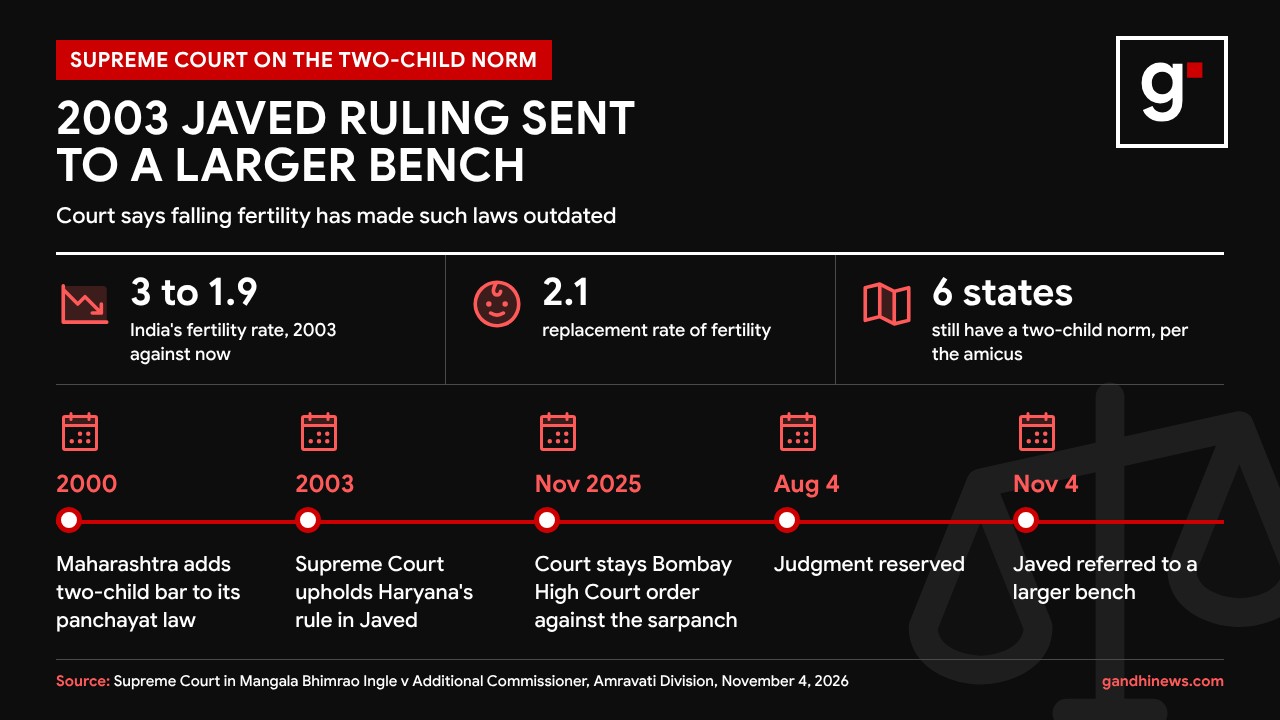
- India's fertility rate has fallen from 3 in 2003 to 1.9, below the replacement rate of 2.1.
The Supreme Court on Wednesday said that laws punishing people for having more than two children have lost their relevance, and asked a larger bench to look again at its own 2003 judgment that upheld such a rule for panchayat elections.
A bench of Justices PS Narasimha and Alok Aradhe, with Justice Narasimha pronouncing the verdict in open court, said the country had changed since then. “We are of the strong opinion that the laws which penalise having more than two children have lost their relevance,” the bench said.
Because a two-judge bench cannot overrule a three-judge ruling, the court referred Javed v State of Haryana to a larger bench. “This has compelled us to stay the proceedings; we have referred the matter to a larger bench,” the bench said. In Javed, the court had upheld the Haryana Panchayati Raj Act’s bar on people with more than two children.
A sarpanch and her third child
The case was brought by Mangala Bhimrao Ingle, a former sarpanch of Kakoda gram panchayat in Maharashtra. She was disqualified under Section 14(1)(j-1) of the Maharashtra Village Panchayats Act, 1959, after the birth of her third child. The two-child bar entered that law on September 13, 2000.
The additional collector at Buldhana disqualified her in October 2024, the additional commissioner of Amravati Division dismissed her appeal and the Bombay High Court upheld the decision. The Supreme Court stayed the High Court order in November 2025 and reserved its judgment on August 4 this year.
Fertility below replacement
At the heart of the ruling is the fall in India’s birth rate. When Javed was decided, the total fertility rate was 3. It now stands at 1.9, below the replacement rate of 2.1, the bench noted. “Therefore, laws limiting population growth have lost its relevance,” it said.
During the hearings, amicus curiae Rukmini Bobde told the court that seven states have repealed their two-child norms and 15 never had one. Assam, Goa, Gujarat, Maharashtra, Odisha and Uttarakhand still keep the rule. Advocate Pratik Bombarde appeared for the petitioner.
Until the larger bench decides, the two-child norm stays on the books in the states that have it. No date has been set for the larger bench to take up the case.