Key points
- Delhi's average AQI was 402 at 5 am on Friday, up from 387 at 10 pm on Thursday.
- IIT Delhi read 488 and 33 of 58 stations were in the severe band, with Chandni Chowk and North Campus at 476.
- The IMD expects very poor to severe air until November 16, and GRAP Stage III remains in force.
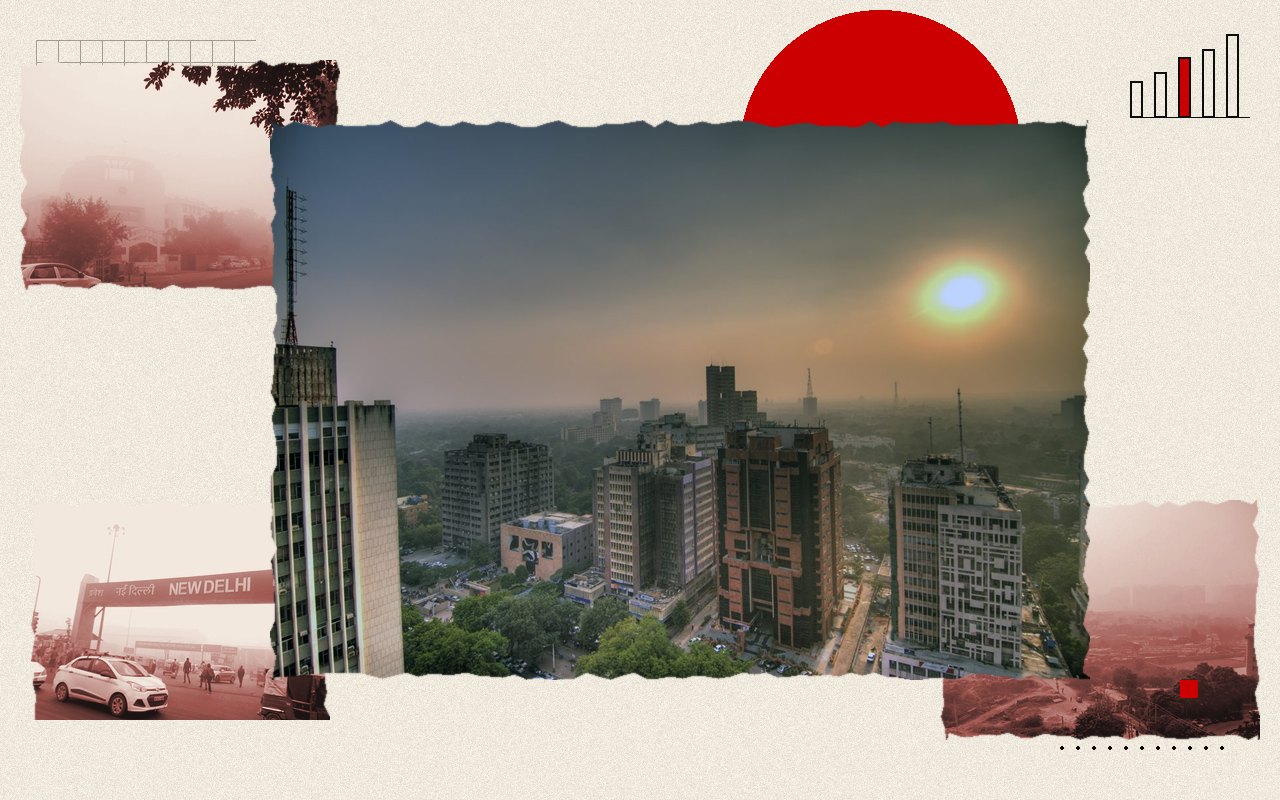
Delhi’s air crossed into the severe band on Friday morning, with the city’s average Air Quality Index at 402 at 5 am, according to Central Pollution Control Board (CPCB) data. It came a day after the index stood at 319 at 6:30 am, when we last reported the readings.
By the morning snapshot, 33 of the 58 monitoring stations were in the severe category, several of them above 450. IIT Delhi recorded 488 at 3 am on the IITM early warning system, the highest in the city. Chandni Chowk and the Delhi University North Campus were both at 476, and Pusa read 468 and Jaffarpur 461. ITO, Mathura Road, Burari Crossing and JNU were between 451 and 455, and Anand Vihar was at 414.
The picture was not uniform. The Dwarka Expressway stood at 369 and RK Puram at 391, both very poor, while Dhaula Kuan on the Ridge side was at 161, in the moderate band.
How the night went
The rolling 24-hour average climbed through Thursday, from 313 at 2 am to 366 at 6 pm and 387 at 10 pm, before passing 400 in the small hours. The CPCB’s official 4 pm bulletin on Thursday had put the daily figure at 350, in the very poor band, so the two series measure different periods and should not be read as a contradiction.
PM2.5, the fine particle that goes deepest into the lungs, more than doubled in 24 hours to 244 micrograms per cubic metre by 6 pm on Thursday. That is over four times the national 24-hour standard of 60. By 10 pm on Thursday, 21 of the 58 reporting stations had already reached severe levels.
Why it got worse
Two things happened together. The air stopped moving, and smoke arrived. The mixing layer, the band of air near the ground in which pollutants disperse, was about 400 metres deep on Thursday afternoon, against 1,400 metres on Tuesday. Average wind inside that layer was 8 km/h, against a usual 13 km/h.
Higher up, north-westerly winds of around 34 km/h at 1 to 2 km carried smoke from crop-residue fires in Punjab and Haryana toward the capital. “Overnight, smoke from crop-residue fires in Punjab and Haryana drifted in from the north-west,” said Sunil Dahiya, founder and lead analyst at Envirocatalysts.
The decision support system forecast issued on Thursday put transport at 18.5% of Friday’s pollution load and stubble burning at 5.3%. The share from farm fires has varied a good deal through the season, so one day’s figure says little about the rest. Our explainer on why farm fires rise in autumn sets out the pattern.
What GRAP says now
The Commission for Air Quality Management (CAQM) invoked Stage III of the Graded Response Action Plan on November 6, when the average was 382, and those curbs, along with Stage I and II measures, are still in force. They include limits on older petrol and diesel four-wheelers, a halt to most construction and demolition, and hybrid classes for primary pupils. We set out the Stage III order at the time, and an explainer on each stage lists what is banned.
Under the commission’s schedule, revised on September 29, 2026, Stage III covers an index of 401 to 450 and Stage IV applies above 450. Stage IV would stop trucks entering Delhi except those running on LNG, CNG, electricity or BS-VI diesel, extend the construction ban to roads, flyovers, pipelines and power lines, and move classes VI to IX and XI to hybrid mode. The schedule lets the commission act ahead of a breach when models and IMD forecasts show the higher level is likely to last. As of this writing, no Stage IV order had been reported.
What residents are told
Doctors are advising masks outdoors. Dr Manoj Sharma, director of internal medicine at Fortis Hospital, Vasant Kunj, recommended N95 masks in polluted areas but cautioned against exercising while wearing one, and said children are especially vulnerable.
The political argument over the readings has not gone away. Our report on the Diwali night data covers the Centre for Research on Energy and Clean Air’s finding of 255 missing hourly PM2.5 readings across 59 stations between November 8 and 9, and the Aam Aadmi Party’s claim that the official index understated the pollution. The agency said it had not established that every missing reading was above the instrument limit.
What happens next
The India Meteorological Department expects the air to stay between very poor and severe until November 16, with maximum temperatures of 27 to 30 degrees Celsius and minimums of 14 to 17 degrees through November 15, and no rain. Better winds could bring some relief after that. The CPCB’s 4 pm bulletin today will give the official 24-hour average for Friday, and the commission will decide whether Stage III is enough. Stage IV comes into play only if the index goes above 450 or the forecast says it will.
The documents
- Graded Response Action Plan for Delhi-NCR (revision of September 29, 2026)Commission for Air Quality Management, September 29, 2026