OpinionOur view
A coastal freight target for 2047 is too far away to hold anyone to. Set one for 2030
Sarbananda Sonowal wants ships and barges to carry 12% of India's freight by 2047, double today's share. The goal is right. Without yearly numbers and nearer deadlines, it is a promise nobody now in office will have to answer for.
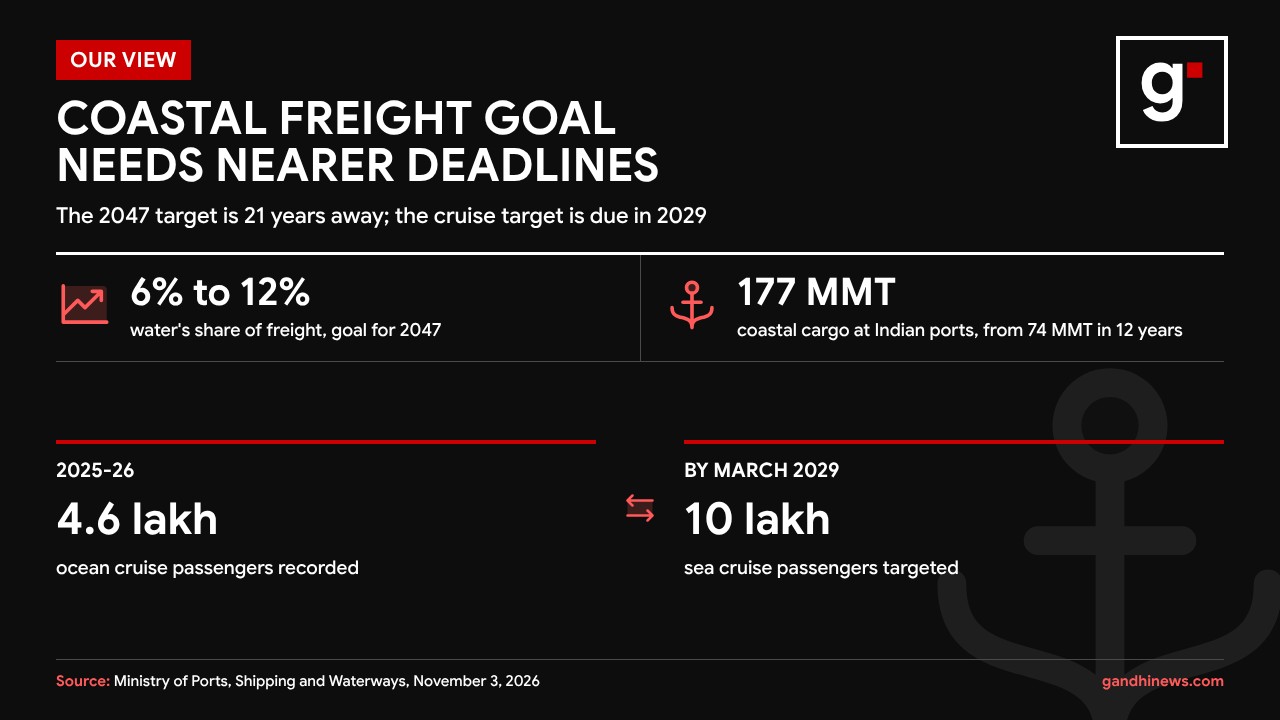
On Tuesday, at a meeting of MPs in Puri, Union Shipping Minister Sarbananda Sonowal set out a goal worth having. India’s coastline and rivers carry about 6% of the country’s freight. By 2047, he said, they should carry 12%. “Our coastline and our rivers are being turned into engines of growth,” he told the committee.
He is right that they should be. A country with a long coastline, a ring of ports and big rivers still sends most of its bulk cargo by road and rail. Ships and barges are cheaper per tonne over long distances and burn less fuel. The ministry says its two schemes could save 16 million tonnes of carbon dioxide emissions.
A target set for 21 years away
The trouble is the date. 2047 is 21 years away. Several governments and many ministers will have come and gone by then. A target that far off cannot be missed in any year that matters, which means it can never quite be failed.
The progress so far also needs reading with care. Coastal cargo at Indian ports has grown from 74 million tonnes to 177 million tonnes in 12 years. That is a real rise. Yet the ministry still puts water’s share of freight at about 6%. Tonnes handled at ports alone will not tell us whether cargo is actually shifting off the roads.
Puri shows how slowly things move
The cruise terminal promised for Puri is a small test of the same problem. In October 2025 the Paradip Port Authority said the project was at the detailed project report stage. In September this year the Odisha government told its Assembly that a feasibility report was still being prepared, for a site of about 60 acres near the mouth of the Dhanasri river at Sipsubali, with a target of March 2028. On Tuesday it was announced again, at a likely cost of ₹1,500 crore.
The cruise target is nearer and harder. The Cruise Bharat Mission aims for one million sea cruise passengers by March 2029. India recorded 4,62,661 in 2025-26. Passenger numbers must more than double in about three years.
The fair objection
Ports, waterways and terminals take a decade or more to build. Coastal shipping depends on cargo owners changing long habits, and road transport will keep its door-to-door advantage. A long horizon gives planners room to get the basics right, and setting yearly targets for a market the government does not control could invite fudged numbers.
That is a reason for honest milestones, not for none.
What the ministry should do
First, set a milestone for 2030 on the way to 2047, so that the people who announced the goal can be judged on it.
Second, publish every year the share of India’s freight that moves by coast and inland waterway, measured in tonne-kilometres and not only tonnes handled at ports.
Third, judge the Coastal Cargo Promotion Scheme, announced in this year’s Budget, by how much cargo it moves off the roads, and say so in public each year.
Fourth, give the Puri terminal a fixed timetable with costs, and consult the town, its pilgrims and its fishing families on the site before work begins.
Ambition at sea is welcome. It will be believed when it comes with numbers that can be checked before 2047.
The reporting behind this view
- 6% to 12%water's share of India's freight now, and the goal for 2047
- 177 MMTcoastal cargo at Indian ports, up from 74 million tonnes in 12 years
- 4,62,661ocean cruise passengers in 2025-26, against a goal of one million by March 2029