OpinionOur view
India counts its ranked universities. Asia is counting how fast they improve
India now has 325 universities in the QS Asia list, but IIT Delhi, IISc and the older IITs all slipped and only six remain in the top 100. The weak spots QS keeps pointing to are ones that policy can fix.
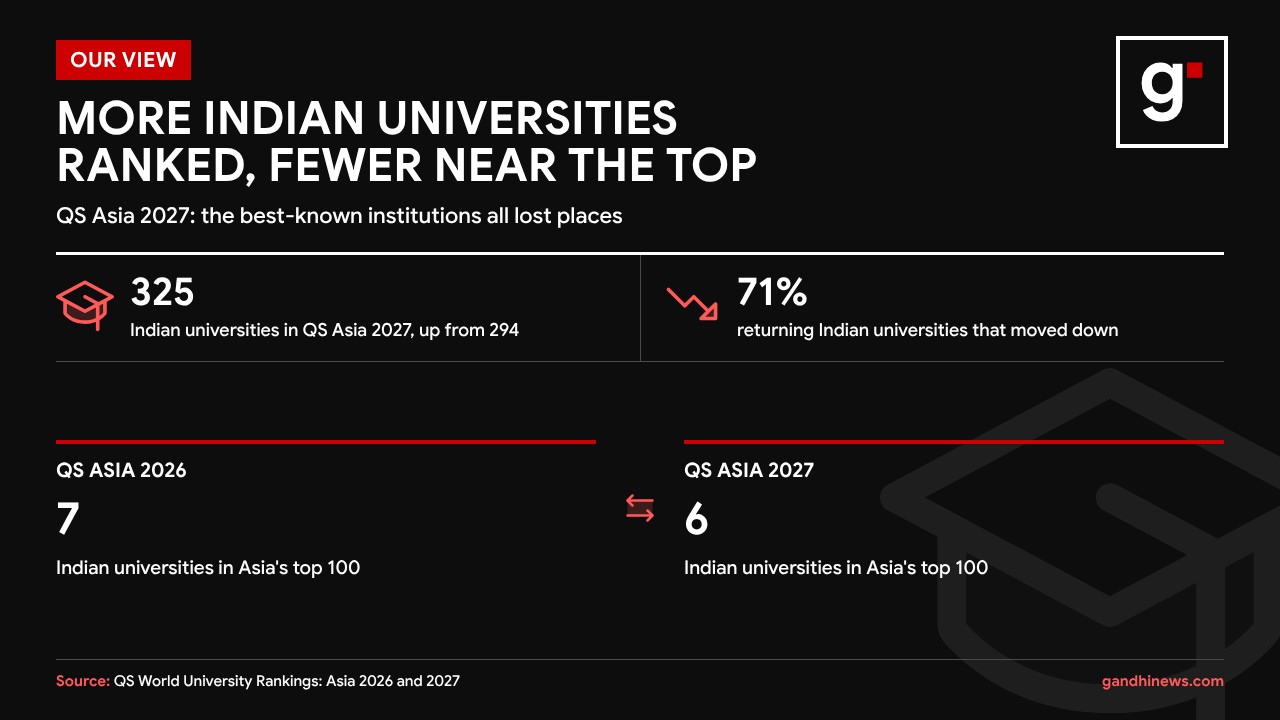
Every year the government and universities greet the QS tables with a number: how many Indian institutions made the list. On that measure the QS Asia University Rankings 2027, released on Tuesday, are another success. India has 325 universities in the table, up from 294 a year ago, second only to mainland China.
Read past the count and the picture changes. Of the Indian universities that were ranked last year, 71% moved down. Only 18% rose. IIT Delhi, still India’s best, fell from 59th to 66th. The Indian Institute of Science dropped from 64th to 79th, IIT Bombay from 71st to 83rd and IIT Madras from 70th to 85th. The University of Delhi left the Asian top 100. India now has six universities in Asia’s top 100, one fewer than last year.
Not a collapse, but a warning
QS itself urges calm. Ben Sowter, its senior vice president, said the 71% figure is the share of institutions that moved down, not a fall in performance of that size, and that two-thirds of the Indian universities that lost rank improved their scores. Rivals elsewhere in Asia simply improved faster.
That is meant as reassurance. It ought to worry us more. A university that gets better and still loses ground is running in a race whose pace is set by others. Standing still is no longer an option, and modest improvement is not enough either.
The weak spots are known
None of this is a mystery. When India slipped in last year’s Asia list, QS put it down to rivals’ progress in recruiting international faculty, attracting students from abroad and improving faculty-student ratios. In June, when 52 Indian universities entered the world rankings and Education Minister Dharmendra Pradhan said the result “reflects the transformative impact of NEP 2020”, the same report noted that academic reputation had improved for only 8% of them and declined for 28%. Low numbers of foreign teachers and students, QS said, “suggest the system’s strengths are still under-recognised internationally”.
India produces about 5.5% of the world’s indexed research papers, third by volume. But, as QS put it, “volume alone does not move reputation scores”. Papers are not prestige. Reputation comes from people abroad knowing, citing, visiting and wanting to work with Indian departments.
The fair objection
Rankings are a commercial product. Their methods change, and QS has said that adding more universities makes results more volatile. An Indian university’s first duty is to teach millions of students well and affordably, not to impress a survey of foreign academics. A ministry that chases league tables could neglect state universities that will never appear in them.
All fair. But the indicators India keeps losing on are not vanity. A good faculty-student ratio means smaller classes. Foreign faculty and students bring ideas and links that Indian students benefit from. Reputation decides whether our best researchers stay and whether good ones come.
What should change
First, the government should stop announcing the count of ranked institutions as an achievement. It should report where the leading universities moved, and why.
Second, the IITs, IISc and central universities should be free to hire foreign and overseas Indian faculty on competitive terms, with quick visas and without years of approvals.
Third, teaching posts that sit vacant should be filled before new campuses are opened. The ratio of teachers to students is a number every university controls.
Fourth, research funding should reward quality and collaboration, not the number of papers, so that volume turns into reputation.
India has built a large system. The Asian table says it now has to build a better one, and quickly, because everyone around it is.
The reporting behind this view
- 325Indian universities in the QS Asia 2027 list, second only to mainland China
- 71%of returning Indian universities moved down; 18% rose
- 59th to 66thIIT Delhi's fall, while still India's top-ranked university