Key points
- Andhra Pradesh now puts Cyclone Murasu's damage at ₹2,484 crore, up from ₹1,919 crore on November 6.
- Roads (₹888.84 crore) and agriculture (₹874.97 crore) make up about 70% of the loss.
- Chandrababu Naidu has asked the central team to report within 10 days so that aid can follow.
Andhra Pradesh has raised its estimate of the damage caused by Cyclone Murasu to ₹2,484.43 crore, after a ground assessment added about ₹565 crore to the ₹1,919.59 crore first reported on November 6. The figure, as of November 12, covers 17 sectors, and Chief Minister N. Chandrababu Naidu has asked the Centre for immediate assistance for relief, rehabilitation and reconstruction.
The cyclone crossed the coast on November 3 and affected 106 mandals and 315 villages in Prakasam, Bapatla, Guntur, Krishna, NTR, West Godavari and Eluru districts. About 1.93 lakh people in 48,054 families faced severe hardship, and 746 villages and urban local bodies were inundated.
Where the money was lost
Roads and buildings took the largest share, ₹888.84 crore, with 1,385 km of roads damaged, 36 breaches and 65 culverts destroyed. Agriculture follows at ₹874.97 crore: crops on 1,43,617 hectares were damaged, affecting 1,86,063 farmers. Paddy losses were put at about 80% in East Godavari and 90% in Eluru. Horticulture accounts for ₹337.10 crore, with mango and papaya plantations badly hit on 6,756 hectares.
The remaining ₹383 crore is spread across power, irrigation, housing, health, fisheries, schools, drinking water, livestock and handlooms. More than 10,000 11 kV poles and 1,448 distribution transformers were damaged. In irrigation, 369 sources were damaged with 509 breaches. In all, 3,859 houses were damaged, 645 of them huts, along with 39 medical facilities, 53 schools and 346 fishing boats. In 25 urban local bodies, 3,146 streetlights and 10.8 km of roads were damaged. The assessment says 10,108 handloom weavers were affected.
The state’s report attributes nine deaths to cyclone-related incidents without separating the two storms that hit the coast in a fortnight. Relief teams included 13 NDRF teams, 11 SDRF teams and 390 fire personnel, who rescued 335 people. Officials distributed 63,688 food packets and 54,756 water packets and ran 253 medical camps. Emergency relief spending so far is ₹37 crore.
The central team’s visit
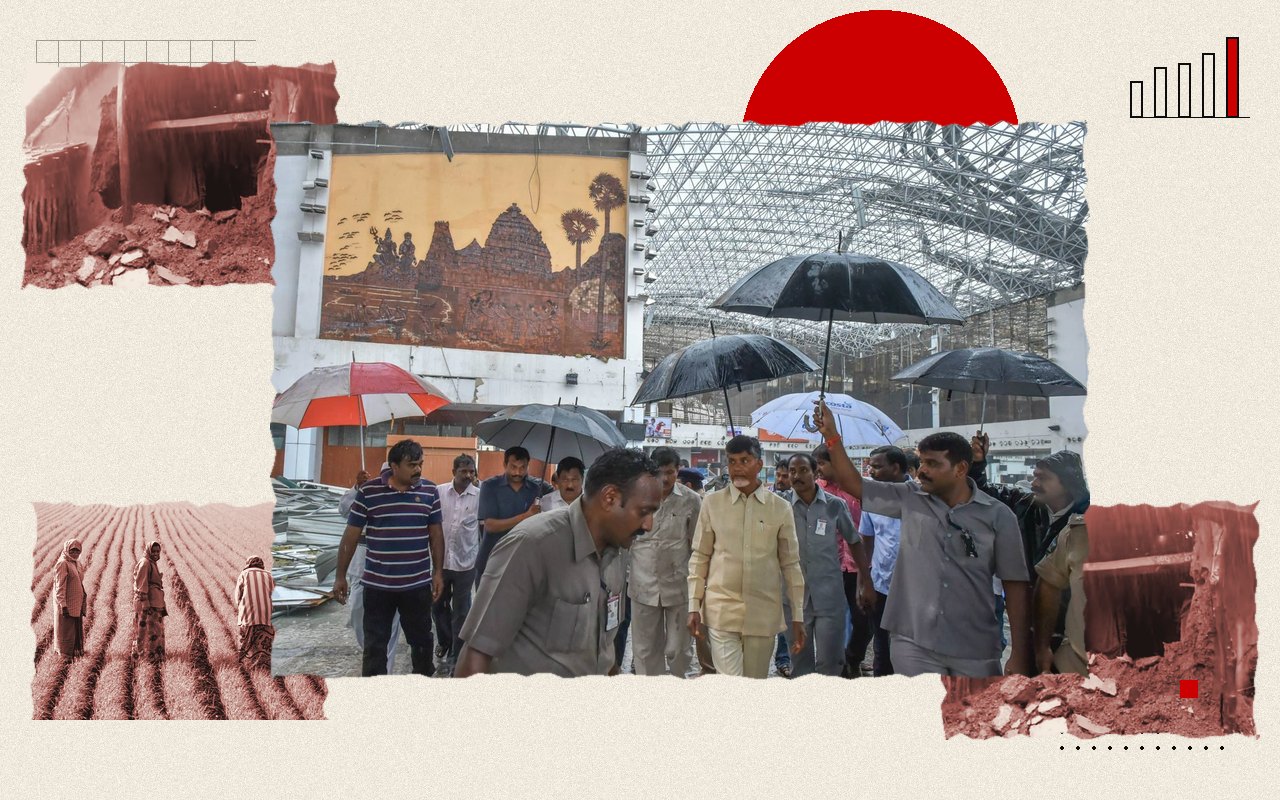
An inter-ministerial central team arrived on Friday, November 13. Led by Chittaranjan Das, a joint secretary in the Union Home Ministry, the seven-member team visited about 60 locations in Bapatla, Palnadu, Eluru and East Godavari. Members inspected roads, canals, houses, farmland and fishing boats, and spoke to farmers standing in submerged paddy fields such as those at Ravulaparru in Eluru district. The team then held a virtual meeting with Mr Naidu.
The team found the damage in East Godavari greater than that caused by Cyclone Arnab. It flagged heavy damage to rural roads and electricity infrastructure, and noted that high premiums had kept farmers growing commercial crops such as cotton from buying crop insurance.
Its recommendations include special assistance for Particularly Vulnerable Tribal Groups, higher compensation for organic and natural-farming cultivators, and a review of extra ration distribution and pre-school uniforms for government school children.
What the Chief Minister asked
Mr Naidu described two successive cyclones during El Nino conditions and said that precautionary steps and quick restoration had brought back roads, power and mobile connectivity within 24 hours. He asked the Centre to release funds without delay, to speed up crop insurance payouts to farmers and to support cyclone-resilient infrastructure. He asked the team to submit its report within 10 days.
Two storms, one fund
Murasu came days after Arnab, which hit the coast early on October 28 and caused an estimated ₹4,764 crore in losses. The state asked the Centre for ₹4,563.23 crore in interim relief on October 29. Together the two storms put heavy pressure on the State Disaster Response Fund. It opened the year on April 1 with ₹4,611.80 crore, to which ₹658.84 crore was added by October 26, while liabilities stand at ₹4,925.09 crore, more than the money available.
Two cyclones in a fortnight
- October 28Cyclone Arnab hits the Andhra coast; losses put at ₹4,764 crore
- October 29State seeks ₹4,563.23 crore in interim relief from the Centre
- November 3Cyclone Murasu crosses the coast
- November 6First estimate of Murasu damage: ₹1,919.59 crore
- November 12Ground assessment lifts the figure to ₹2,484 crore
- November 13Central team arrives and tours the affected districts
Why it matters
For farmers in Eluru, East Godavari and Bapatla, the immediate questions are compensation and insurance. The central team’s note that many growers of commercial crops hold no cover means payouts will depend largely on state and central relief rather than insurance claims. Rural roads and power lines, which carry the heaviest repair costs after farm losses, determine how fast villages return to normal.
What happens next
The central team’s report is due within 10 days, as requested by the Chief Minister. No response from the Centre and no approved funds for either cyclone had been reported when this story was written.