Key points
- Modi told FICCI that industry must stop treating the home market as an assured buyer for anything it makes, and must stop selling on the label 'export quality'.
- He asked whether the cut in the basic corporate tax rate from 30% to 22% and the ₹12 lakh income-tax exemption had led to higher pay and more hiring.
- He asked industry to make 'India First' the basis of every long-term investment over the next 20 years and to use India's free trade agreements.
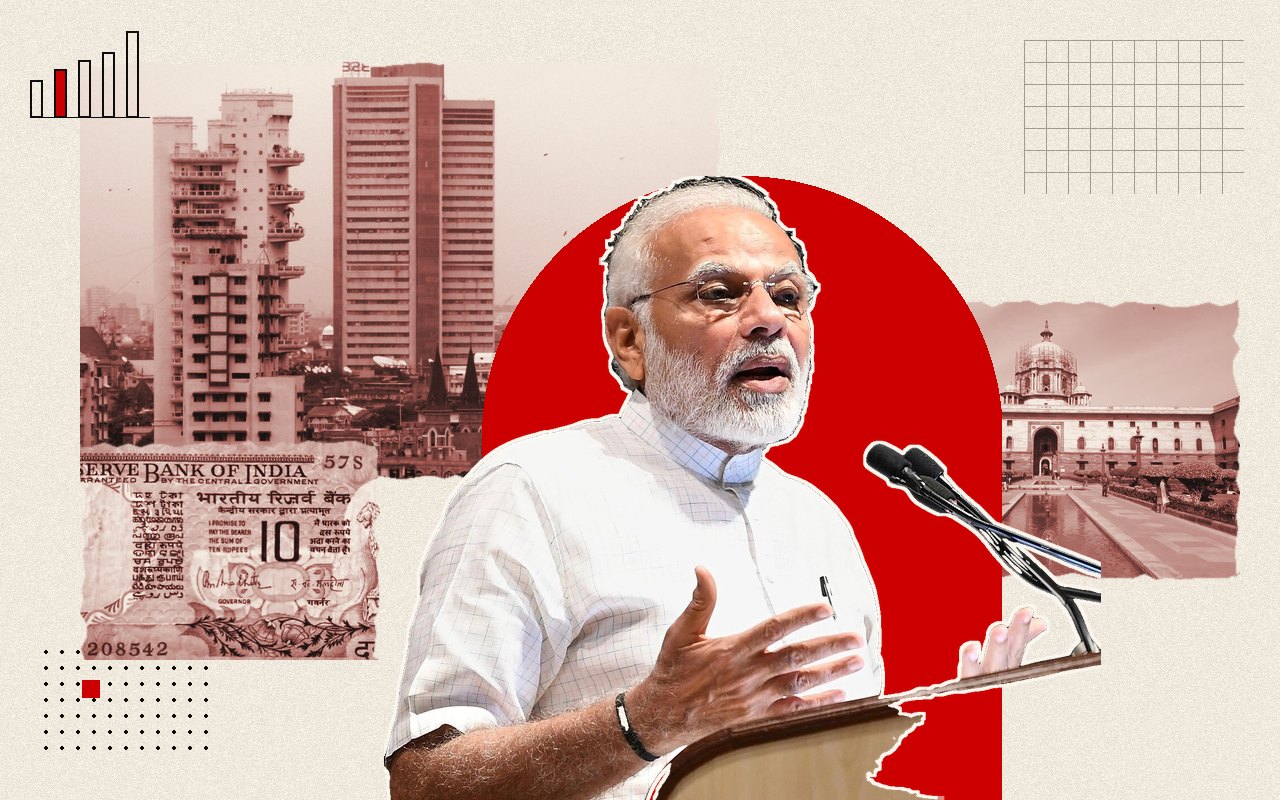
Prime Minister Narendra Modi told India’s business leaders on Thursday that they had left the work of self-reliance undone for a century, and asked them to stop treating India’s 140 crore people as an assured market. He was inaugurating the annual general meeting and annual convention of the Federation of Indian Chambers of Commerce and Industry (FICCI) at Bharat Mandapam in New Delhi, in the chamber’s centenary year.
The address, released by the Prime Minister’s Office at 1:44 pm, was less a celebration than a set of questions put to the room: had the tax cuts produced jobs, had the trade agreements been put to use, and why does India still import what it can make.
What the Prime Minister said
Modi began with the case for the last 12 years. He said India had seen the licence-quota raj, “the failed experiment of nationalisation”, and a period in the 21st century when it was counted among the “Fragile Five” economies. Today, he said, India is the fastest-growing major economy and 50 crore Indians have come out of poverty in 12 to 13 years, citing the World Bank’s latest report. He contrasted that with the “Garibi Hatao” slogan of the 1970s, when the population was about 50 crore, and said policy and intent had both fallen short then.
He cited goods exports of about $50 billion in October, the highest monthly figure on record, and said rating agencies and lenders from Moody’s, S&P and Fitch to the World Bank and the Asian Development Bank were revising India’s growth forecasts upward, to about 7%. “I am singing your praises, and you are asleep,” he told the audience.
Figures in the address
- 30% to 22%basic corporate tax rate, 2014 to now
- ₹12 lakhincome below which no tax is paid
- 13% to 20%+processed food in agri-food exports over 12 years
- 2 to 2.5%India's share of global agriculture exports
The questions for industry
The sharpest passage concerned tax. Modi recalled that in 2014 the basic corporate rate was 30% and said the government had brought it to 22%, and that there is no income tax on earnings up to ₹12 lakh. He said he knew the audience would not applaud, “because your hunger is such that however much one feeds, the stomach does not fill”. He then asked: “Did you raise your employees’ salaries? Did you increase the number of your employees?” His answer, delivered in the same tone, was that industry’s attitude was: “Modi ji, you do it, we will see.”
He added that refunds, once held up for eight months, now arrive within a week, and that GST reforms had cut tax on many products and raised demand, “the direct benefit of which goes to our industry and business houses”.
On quality, he said the home market of 140 crore is sometimes industry’s trouble, because producers assume that whatever is made will sell. “Do not go about treating 140 crore countrymen as an assured market,” he said. He criticised sellers who tell Indian buyers that a product is “export quality”, and asked whether Indians were not entitled to good quality themselves. “This thinking has to change,” he said.
Gandhi, 1930 and the import list
Modi told the audience that Mahatma Gandhi had come to FICCI in 1930 and said the same things, and that he was repeating them a century later. “Is it your success or your failure?” he asked, adding that Gandhi too had spoken of swadeshi and an Atmanirbhar Bharat. He suggested the chamber attach those two sentences to the documentary it had just screened and carry them to every home.
He then listed where India still depends on imports. The pharmaceutical industry, though called the pharmacy of the world, imports billions of dollars of active ingredients, bulk drugs and intermediates every year, in hundreds of categories. India exports iron ore worth thousands of crores but imports finished steel; it has large bauxite reserves but imports specialised aluminium alloys. “How can a country export wheat and import bread?” he asked.
Farm exports and trade deals
On agriculture, Modi said India’s share of global agricultural exports is only two to two and a half per cent, and that the corporate sector “is afraid of, and runs away from, investing in agriculture”. He said processed food’s share of agri-food exports had risen from 13% to over 20% in 12 years, and asked industry to draw up a joint strategy matched to world demand, with dependable procurement for specific overseas markets. He also pointed to hand tools, power tools, packaging equipment, irrigation systems and factory machinery as export openings, especially for the Global South.
On trade, he asked whether FICCI members had ever sat down to plan for the free trade agreements India has signed with large economies. “When a free trade agreement is signed with a big economy, it means doors have opened for you,” he said. India’s recent agreements include the New Zealand pact that came into force on October 20, and the European Union deal, whose signing in Brussels is expected in December. Commerce Minister Piyush Goyal has been taking the agreements to the states to help small firms and farmers export.
An invitation and a swipe
Modi also asked for criticism in writing. “This is not the old government. This is a friendly government,” he said, and asked industry to write to him “without hesitation” about the reforms still needed, adding that if two in a hundred suggestions were taken up, the shortfall would be the government’s. He repeated that the home market “should not be our comfort zone” and said it should give confidence to compete abroad.
In a passage on respect for taxpayers, he said a country does not progress “by abusing them morning and evening”, and recalled telling a gathering of income-tax officials in Gujarat in 2001 or 2002 to stop treating everybody as a thief. He did not name any party or person.
Why it matters and what comes next
For industry, the speech links the government’s tax concessions to a demand for results. Exports are the measure Modi chose: October’s goods shipments were a record $49.47 billion, up 45% on a year earlier, and the government is aiming at $1 trillion of exports this financial year. For consumers, his remarks on “export quality” put domestic quality standards on the agenda of the country’s largest business lobby, which represents more than 2.5 lakh companies directly and through affiliates.
He closed with a challenge: do not wait another 100 years, ask what industry can give the country in 10, and if India could become free within 20 years of FICCI’s founding in 1927, it can become a developed nation in 20 years from its centenary. FICCI completes 100 years on April 7, 2027. No response from the chamber or from opposition parties had been published when this report was written.
The documents
- Text of PM's address at the inauguration of FICCI Annual General Meeting and Annual Convention in DelhiPIB, Prime Minister's Office, November 19, 2026
- PM to inaugurate FICCI Annual General Meeting and Annual Convention on 19 NovemberPMO, November 18, 2026