The short answer
Bal Vivah Mukt Bharat is the Union women and child development ministry's campaign, launched on November 27, 2024, to make India free of child marriage by 2030, with an interim aim of cutting its prevalence by 10% by 2026. Marking two years on November 27, 2026, the ministry reported outreach to over 12 crore people and 42 lakh pledges, but no new prevalence figure. The latest national number, from the National Family Health Survey of 2023-24, is 20.1% of women aged 20 to 24 married before 18, down from 23.3% in 2019-21, a fall recorded before the campaign started.
What is Bal Vivah Mukt Bharat?
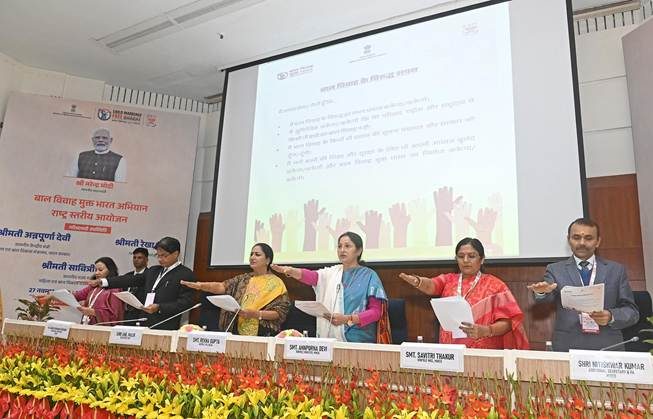
A national campaign to end child marriage in India by 2030, run by the Union Ministry of Women and Child Development. It was launched on November 27, 2024 at Vigyan Bhawan in New Delhi. The ministry said at the time that “almost 1 in 5 girls” were still being married before the legal age of 18.
The campaign rests on awareness drives, community pledges, an online portal for reporting, and the Child Marriage Prohibition Officers (CMPOs) whom states must appoint under the law. In January 2026 the government’s own backgrounder set out its two numbers: reduce the prevalence of child marriage by 10% by 2026, and make India child marriage free by 2030, the deadline in the UN Sustainable Development Goal on ending child, early and forced marriage.
What did the ministry report at two years?
Outreach, not outcomes. At a national event on November 27, 2026, the ministry said its awareness programmes had reached over 12 crore citizens, more than 42 lakh pledges had been registered on the campaign portal and two government platforms, and the portal now lists more than 72,000 CMPOs across states and Union Territories. About 700 people attended in Vigyan Bhawan and about 47,000 watched online.
What the release does not give is how many child marriages there are now, how many were stopped, or how many cases were filed. The launch release of 2024 had expected the pledge to reach “up to 25 crore citizens”; the two-year count is 12 crore reached by awareness programmes.
Women and Child Development Minister Annpurna Devi said the goal was that every child gets “a safe childhood, every daughter gets the opportunity for education”, and that “child marriage will not happen in our home, our neighborhood, or anywhere in the country”. Minister of State Savitri Thakur called a child marriage free India “not just a target for 2030”.
The campaign's own numbers at two years
- 12 crore+people reached by awareness programmes
- 42 lakh+pledges registered online
- 72,000+Child Marriage Prohibition Officers on the portal
- 10% by 2026the interim cut in prevalence the campaign aimed for
So was the 2026 target met?
Nobody can say yet, because there is no measurement after the campaign began. The figure India uses for child marriage comes from the National Family Health Survey (NFHS): the share of women aged 20 to 24 who were married before 18. The sixth round, whose fact sheets were released on May 29, 2026, puts it at 20.1% in 2023-24, down from 23.3% in 2019-21.
That is a fall of about 13.7% between the two surveys by our arithmetic, more than the 10% the campaign aimed for. But NFHS-6 was carried out in 2023-24, before the campaign was launched in November 2024, so it measures the trend the campaign inherited, not the campaign’s effect. The backgrounder also does not say whether the 10% is measured from the NFHS-5 figure or from some other base year, or which survey will be used to check it.
The longer trend is clear. In 2005-06 the share was 47.4%; it fell to 26.8% in 2015-16, 23.3% in 2019-21 and 20.1% in 2023-24. The fall has slowed: about 21 percentage points in the first decade, about 7 in the eight years after that.
Is it only about girls?
No, though girls are married young far more often. NFHS-6 also records that 15.9% of men aged 25 to 29 married before 21, the legal age for men, down from 17.7% in 2019-21. In rural India the share of women aged 20 to 24 married before 18 is 23.3%, against 27.0% in the previous round. The January backgrounder named West Bengal, Uttar Pradesh and Bihar among the states with the highest incidence.
What does the law say?
A marriage where the woman is under 18 or the man under 21 is a child marriage, and it can be undone. Under the Prohibition of Child Marriage Act, 2006, such a marriage is voidable at the option of the party who was a child, by a petition to the district court within two years of reaching majority. It is void from the start if it involved trafficking, force or deceit.
Offences under the Act are cognizable and non-bailable. An adult man who marries a child, and anyone who performs, promotes or attends such a marriage, including parents, faces up to two years’ rigorous imprisonment and a fine of up to ₹1 lakh; women offenders cannot be imprisoned. Magistrates can issue injunctions to stop an impending marriage, and a marriage held in breach of one is void. The backgrounder adds that under the Bharatiya Nyaya Sanhita, a sexual act by a man with his wife who is under 18 is rape.
What did the Supreme Court order?
Full-time officers and prevention, not only prosecution. In its judgment of October 18, 2024 in Society for Enlightenment and Voluntary Action v. Union of India, the court directed states and Union Territories to appoint full-time Child Marriage Prohibition Officers at district and sub-district level, without other duties, and to set up special units to coordinate and monitor. It also said child betrothals should be prohibited and urged Parliament to ban them explicitly.
The two-year release counts 72,000 CMPOs on the portal. It does not say how many are full-time, which is what the court asked for.
What happens next?
A 100-day awareness drive, the campaign’s Awareness Module 2.0, runs until December 21, 2026. The next real test is data: the 2026 target will only be checkable when a survey with fieldwork after November 2024 is published, and the 2030 goal of zero is measured against a national figure that, at the last count, was still one woman in five.
Child Helpline 1098, the emergency number 112 and Women Helpline 181 take reports of an impending child marriage, as does the campaign portal at stopchildmarriage.wcd.gov.in.
The documents
- Ministry of Women and Child Development marks two years of 'Bal Vivah Mukt Bharat' Campaign (Release ID 2342751)Press Information Bureau, Ministry of Women and Child Development, November 27, 2026
- Bal Vivah Mukt Bharat: A Pledge Towards Child Marriage-Free India (backgrounder)Press Information Bureau, January 8, 2026
- Smt. Annpurna Devi to launch a National Campaign 'Bal Vivah Mukt Bharat' tomorrow to make India child marriage free (Release ID 2077572)Press Information Bureau, Ministry of Women and Child Development, November 26, 2024
- NFHS-6 (2023-24): Key Findings and Long-Term TrendsConsulate General of India, São Paulo (Ministry of External Affairs), reproducing the Ministry of Health and Family Welfare's findings, June 13, 2026