Key points
- The ITU Plenipotentiary Conference in Doha, which ended on November 27, 2026, formally accepted India's offer to host PP-30 in 2030, the Department of Telecommunications said.
- The conference is the ITU's highest policy-making body: it adopts the agency's strategic and financial plans and elects its Secretary-General, senior officials and Council.
- India was re-elected to the 48-member ITU Council for 2027 to 2030 on November 16, one of 13 seats for Asia and Australasia.
- The government has not yet named a host city, dates or a budget for the 2030 conference.
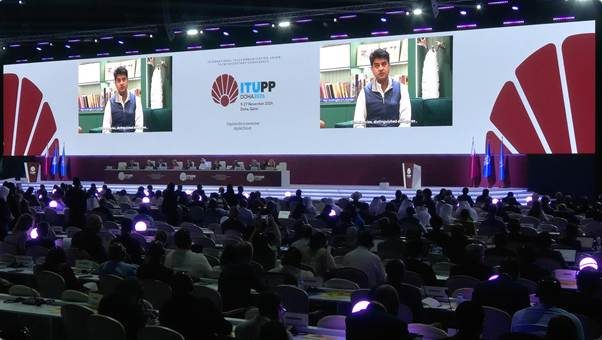
India will host the next Plenipotentiary Conference of the International Telecommunication Union (ITU) in 2030, the UN agency’s highest decision-making meeting. The Department of Telecommunications said on November 27, 2026 that the 2026 conference in Doha, Qatar, which ended that day, formally accepted India’s proposal to host PP-30. The ITU Council had already approved the invitation at its 2026 session in Geneva.
Communications Minister Jyotiraditya Scindia invited the delegates by video message. “Let us come together in India in 2030, not merely to convene a Conference, but to strengthen our bonds of friendship, deepen international cooperation and shape a more connected, inclusive and digitally empowered future for all,” he said.
What the conference decides
The Plenipotentiary Conference meets every four years and brings together the ITU’s 194 member states. In the ministry’s words, it determines “the Union’s overall direction”, adopts its strategic and financial plans, and elects its senior leadership and its Council. It is the one meeting where the rules that govern the agency itself, its constitution and convention, can be changed.
The Doha meeting showed what that means in practice. On November 12, members re-elected Doreen Bogdan-Martin of the United States as Secretary-General, with 164 of the 173 votes cast, for a second four-year term. On November 16 they elected the Council and the 12-member Radio Regulations Board, the body that rules on how the treaty dividing up radio spectrum and satellite orbits is applied.
The ITU’s work touches Indian decisions directly. The radio spectrum that India auctions for mobile services, and the orbital slots its satellites use, are allocated under international rules that ITU conferences write. The global standards behind 5G, and now 6G, are agreed through the ITU.
India’s seat on the Council
India was re-elected to the ITU Council for 2027 to 2030. The Council runs the agency between plenipotentiary conferences, oversees its policies and prepares the draft strategic and financial plans for the next conference. India took one of 13 seats for Asia and Australasia, alongside Australia, Bahrain, China, Indonesia, Japan, South Korea, Kuwait, Malaysia, Qatar, Saudi Arabia, Thailand and the United Arab Emirates.
That puts India on the body that will prepare the agenda of the very conference it is hosting. The ministry said India has been a member of the ITU since 1869 and has sat on its Council continuously since 1952.
India and the ITU
- 2030year India hosts the Plenipotentiary Conference (PP-30)
- 13Council seats for Asia and Australasia, one of them India's
- 1869year India joined the ITU
- 1952India on the Council without a break since
How the bid came through
The process took two years. According to the ministry, India first expressed interest in November 2024, put formal proposals to the ITU Council in 2025, and the Council approved the invitation at its 2026 session and sent it to the Doha conference for acceptance.
The government points to a smaller ITU meeting it ran as proof it can do this. New Delhi hosted the World Telecommunication Standardization Assembly (WTSA-24) in October 2024, which set the work programme of the ITU’s standards arm on subjects including 6G, artificial intelligence and digital public infrastructure. A plenipotentiary conference is larger: it carries the elections for the agency’s top posts and its budget.
What is not yet known
The ministry’s release does not name a host city, dates or a budget for PP-30, or say who will bear the cost. Those are usually set out in an agreement between the host government and the ITU closer to the meeting.
Scindia described the two mandates, the Council seat and the hosting, as “both an honour and a responsibility” and said India was “fully committed to organising a successful, inclusive and memorable Conference”. The 2030 meeting will elect the ITU leadership that follows Bogdan-Martin’s second term, which begins in 2027 and runs four years, so India will be the host when the agency chooses its next Secretary-General.
The documents
- India to Host ITU Plenipotentiary Conference 2030; Union Minister Shri Jyotiraditya M. Scindia Invites Global Telecommunications Community to India (Release ID 2342914)Press Information Bureau, Ministry of Communications, November 27, 2026
- ITU elects members of ITU Council and Radio Regulations BoardInternational Telecommunication Union, November 16, 2026
- ITU Member States re-elect Doreen Bogdan-Martin as Secretary-GeneralInternational Telecommunication Union, November 12, 2026