Key points
- UN Secretary-General António Guterres told the COP31 leaders' summit that fossil fuels must go the way of the dinosaurs.
- He proposed a Climate Justice Compact and a tax on the windfall profits of oil and gas companies.
- China, the US and India, which together emit more than half of global CO2, sent no head of government.
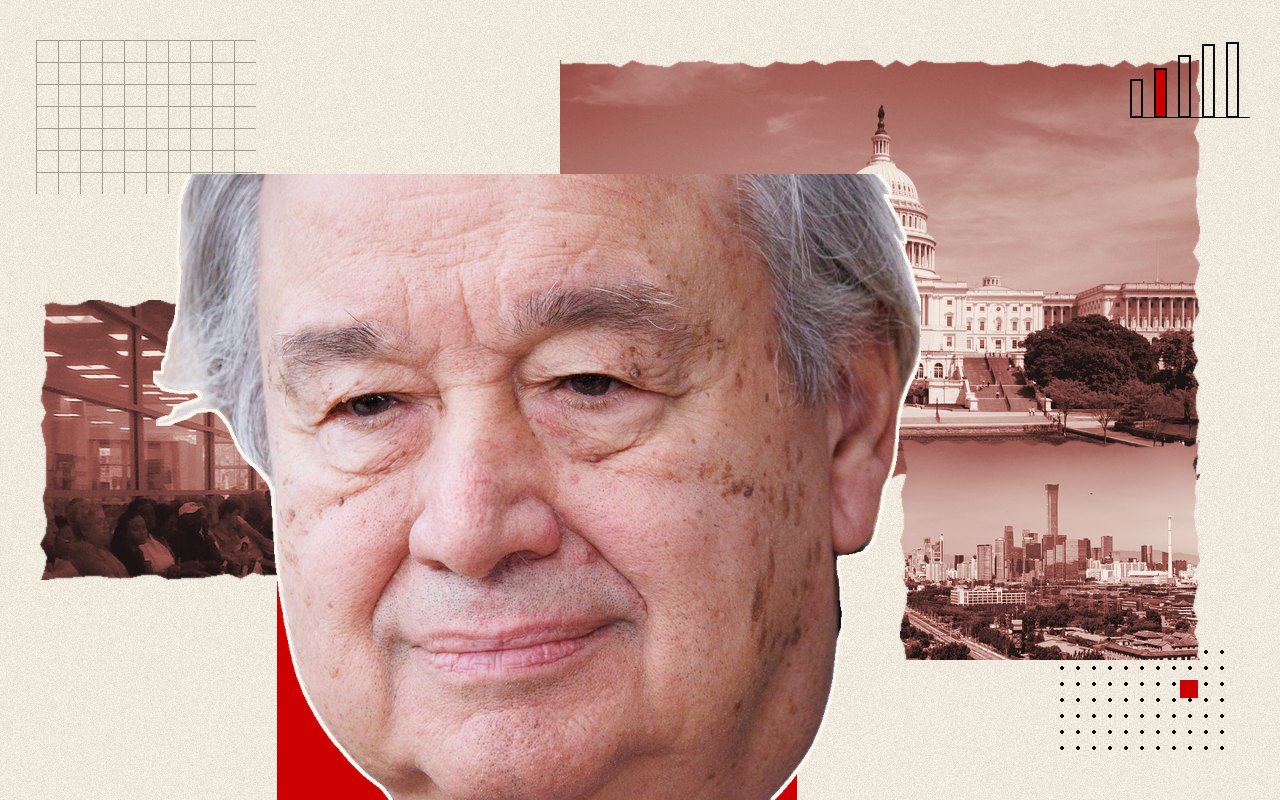
The head of the United Nations told world leaders at the COP31 climate summit in Antalya that fossil fuels “must go the way of the dinosaurs”, in what is his last climate conference before his term ends in December. Speaking at the leaders’ segment that began on Wednesday, November 11, 2026, António Guterres added that the oil and gas industry has “a lobby the dinosaurs lacked” and that governments should tax its windfall profits.
The leaders’ summit runs through Thursday, November 12, 2026, inside a two-week conference that closes on November 20, 2026. It has opened with some of the largest economies missing.
What Guterres asked for
Guterres said the world was moving “far too slowly” and that the climate crisis was “outrunning us”. “We know the truth. Now we must act on it,” he told the hall, calling the effort “the fight for our lives and our children’s future.”
He proposed a Climate Justice Compact, resting on shared responsibility, shared security and shared benefits. According to reports of the speech it has four parts: a just move away from fossil fuels starting with national plans, adaptation plans and early warning systems, adequate and affordable climate finance, and closer cooperation between countries.
He said emerging economies outside China receive less than a fifth of global clean energy investment, that solar alone met nearly three quarters of the growth in electricity demand last year, and that clean power is now the cheapest new electricity across most of the world. He also asked for no new coal, oil or gas infrastructure and said global emissions hit a record in 2025.
Who did not come
China, the United States and India sent no head of government, though together they produce more than half of the world’s carbon dioxide. China was represented by Vice-President Han Zheng. The United States has stayed away from the talks for a second year, and President Donald Trump has sent no officials to climate talks since 2024. Prime Minister Narendra Modi did not attend.
Several European leaders were also absent, among them Emmanuel Macron, Friedrich Merz and Giorgia Meloni, as were Canada’s Mark Carney and Japan’s Sanae Takaichi. Some stayed away because an EU leaders’ summit in Ireland falls on Thursday. EU climate commissioner Wopke Hoekstra called the absences “not completely atypical” but said expectations were not especially high. Mohamed Adow of Power Shift Africa called the turnout “a disgrace”. The UK’s Andy Burnham was the only G7 leader due to speak, and European Commission President Ursula von der Leyen attended.
Climate groups gave their “Fossil of the Day” award to several European countries, Japan and Canada for not showing up.
What leaders said
Brazil’s Lula, re-elected last month, said climate change had faded from leaders’ speeches and documents this year as attention shifted to arms and tariffs. “Brazil is back to defend the continuity of a healthy planet,” he said, and he asked that last year’s roadmaps on fossil fuels, deforestation and finance be carried into the 2028 Global Stocktake.
Turkish President Recep Tayyip Erdoğan, the host, said “climate financing should be more accessible, predictable and cater to the needs” of countries, and that developed nations must take greater responsibility for cutting emissions and for paying for it. Australian Prime Minister Anthony Albanese, whose country leads the negotiations, said projected warming has fallen from about 4°C to around 2.6°C since the Paris Agreement, and pointed to the Pacific Resilience Facility, which holds a pledging event on Thursday.
Both hosts drew criticism at home and abroad. Adam Bandt of the Australian Conservation Foundation said Australia “can’t keep dodging this issue” and urged it to stop opening new coal and gas mines. Neither leader spoke about their own country’s plans for fossil fuels, and both countries are expanding coal mines.
The electrification pledge
The host’s main proposal is the “35 by 35” pledge, which would lift electricity’s share of final energy use from about a fifth now to 35% by 2035. It is voluntary. Australia, Germany, Norway, Finland, Ethiopia and Pakistan have backed it, many with caveats, and the EU has spoken positively. Pakistan’s Prime Minister Shehbaz Sharif said his country had added nearly 22 GW of rooftop solar in two years and needed about $138 billion by 2035 for low-carbon power, adding that “momentum without finance cannot be sustained.”
Critics say the pledge does not require the new power to come from clean sources. Saudi Arabia objected that electrification does not by itself cut emissions. The EU wants the wording to say “clean” electrification. India was reported to be considering staying out of the pledge.
Money and what comes next
Developing countries are looking for clarity on the $300 billion a year that richer countries agreed at COP29 to deliver by 2035 and for progress towards a $1.3 trillion a year goal. The Tropical Forest Forever Facility has raised about $7.9 billion against a $10 billion target, and no government announced a new pledge at the summit. Norway’s $3 billion is conditional on the full $10 billion being raised by the end of the year.
Follow-up high-level meetings are set for November 17 and 18, 2026, and the conference is due to close on November 20, 2026. A UN report found the world is on course to exceed the 1.5°C limit. Former French Prime Minister Laurent Fabius said “the key word in Antalya is implementation.”