OpinionOur view
A special cell for child labour is welcome. It must come with a deadline, a count and a public report
The Supreme Court has told the Centre to set up a cell to enforce the ban on child labour. The law has barred all work by children under 14 for a decade. What has been missing is not a rule but the people, the numbers and the will to apply it.
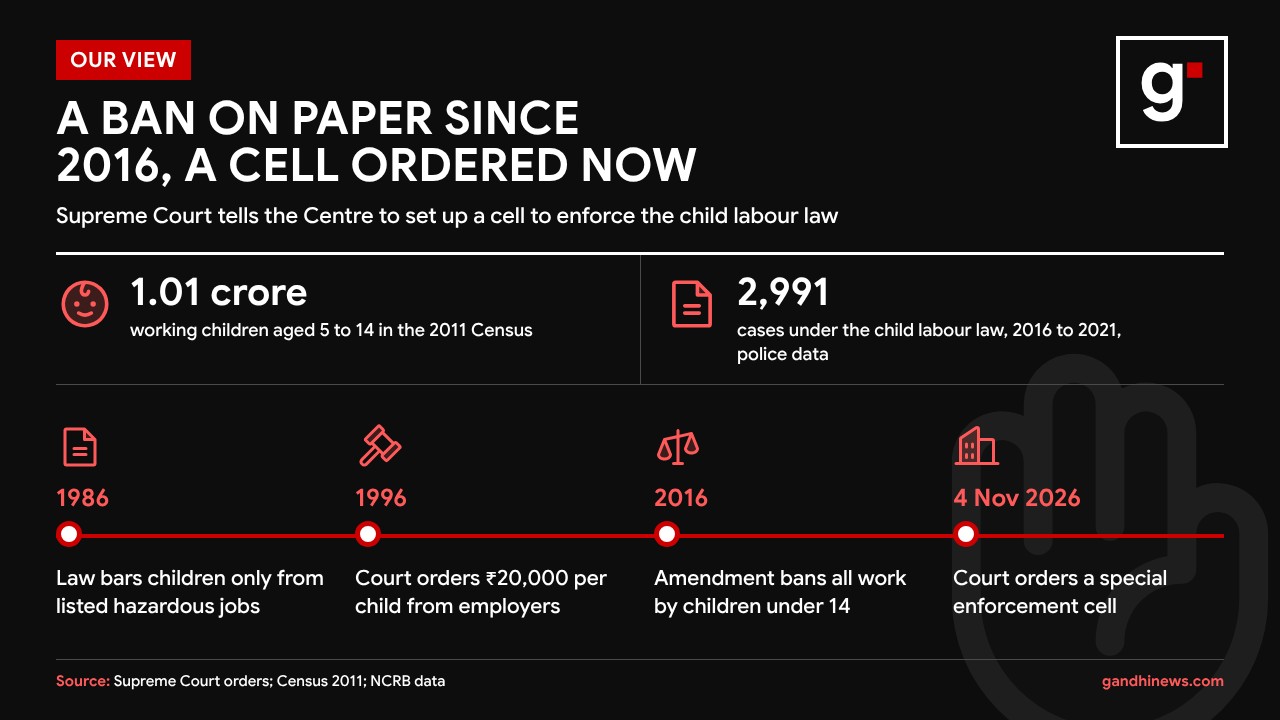
The law has been clear for a decade. Since the 2016 amendment, no child under 14 may be employed in any occupation or process in India, with a narrow exception for helping in a family enterprise after school. On Wednesday the Supreme Court admitted, in effect, that a clear law is not the same as an enforced one. It told the Centre to set up a special cell to monitor the ban and to instruct the states, through their Chief Secretaries, to apply it strictly.
The order closes a petition by Health for Millions that has been pending since 2009. The bench of Justices SVN Bhatti and NV Anjaria said what remained was “giving complete and full effect” to the 2016 amendment. That is the right test. It is also a test the country has been failing.
A gap measured in crores
The last full count, from the 2011 Census, found about 1.01 crore children aged five to 14 at work, nearly four in every hundred. Police data tell a very different story. Between 2016 and 2021, fewer than 3,000 cases were registered under the child labour law across the whole country, a few hundred a year.
The work has not vanished. It has gone unrecorded. A 2025 study by Enfold and CivicDataLab, which went through court records in six states, found roughly eight times as many child labour cases in the courts as in the police figures for the states it studied. When the official numbers are this far from what courts and families see, the problem is not the absence of a law but the absence of anyone counting.
Thirty years of cells
This is not the first time the court has asked for machinery. In 1996, in M C Mehta v State of Tamil Nadu, it ordered employers to pay ₹20,000 for every child employed illegally into a welfare fund, and asked each state to set up a separate cell in its labour department, with district collectors overseeing inspectors. A new cell in Delhi will meet the same fate as those orders unless it is given teeth.
There is also a question of who is in charge. The court has placed the cell under the Women and Child Development Secretary, while the law itself is run by the Labour Ministry and enforced by state labour inspectors. A cell that monitors without commanding the inspectors will produce letters, not rescues.
The fair objection
Many children work because their families cannot manage without the income. A raid that takes a child out of a workshop and sends her home to the same poverty does little good, and can push the family to hide her elsewhere. The family-enterprise exception, too, is easy to stretch. Enforcement alone cannot fix what poverty and weak schools create.
That is an argument for enforcement that comes with rehabilitation, schooling and money for families, not an argument against enforcement. The 1996 order understood this; it tied compensation to the child’s education.
What the Centre should do
First, set up the cell with a deadline, a budget and a named officer, and make it answerable for state labour inspections, not just reports from them.
Second, count again. The coming census and household surveys should record working children directly, so that progress can be measured against something better than a 15-year-old figure.
Third, publish an annual report, state by state: inspections carried out, children rescued, employers prosecuted and fined, and how many rescued children were enrolled in school a year later.
Fourth, close the gaps the court is already hearing about. In May, a separate bench issued notice on a plea to ban children from orchestras, dance bars, spas and salons outright. The Centre need not wait for that verdict to tighten its own schedule.
A child at a loom or a dhaba counter is not hard to find. The state has a law, a court order and now a cell. It should be able to find her too.
The reporting behind this view
- 2016year Parliament banned all work by children under 14, with a family-enterprise exception
- 1.01 croreworking children aged five to 14 counted in the 2011 Census
- 2,991cases registered under the child labour law from 2016 to 2021
The documents
- Supreme Court decision in M C Mehta v State of Tamil Nadu (1996)Government of Bihar (CPMIS)