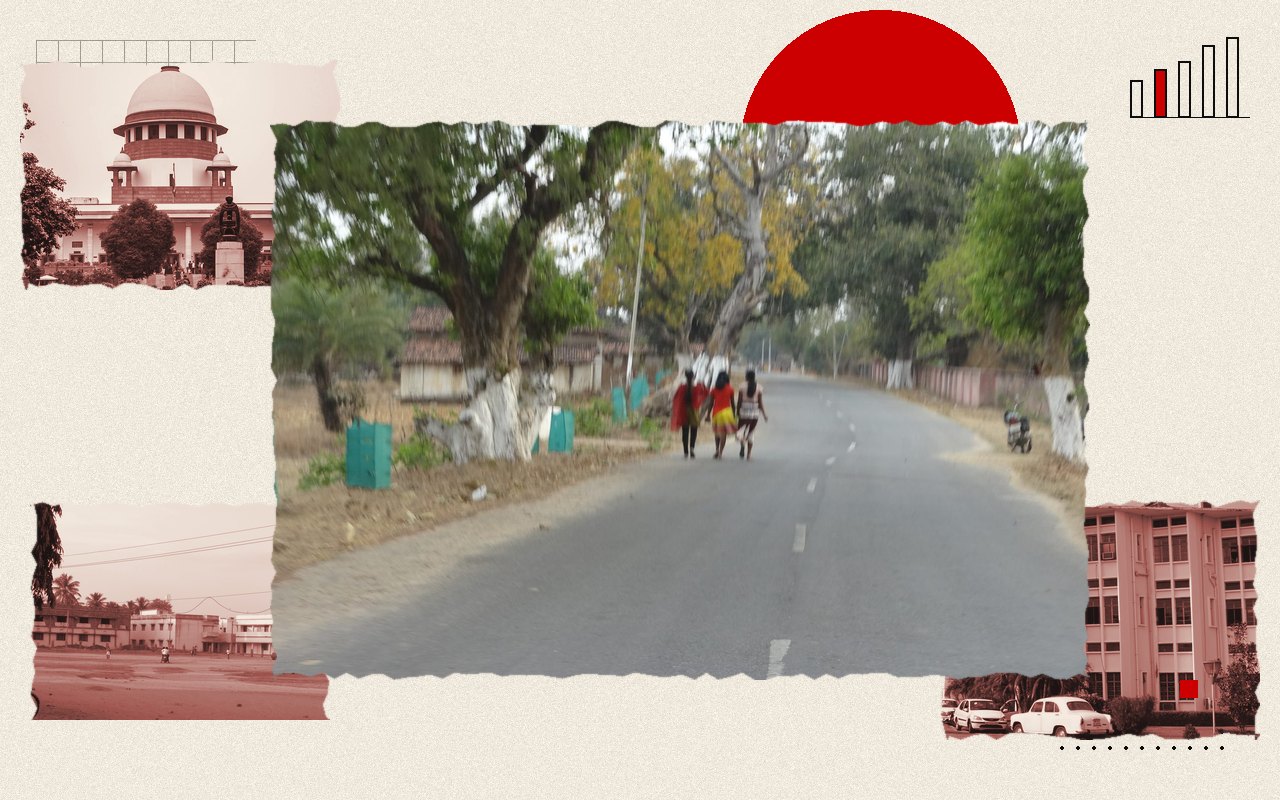
Villagers in three Sundargarh villages said no. On January 26, 2020, the Gram Sabhas and Gram Panchayats of Kukuda, Bihabandha and Lanjiberna unanimously rejected a proposal to hand their farmland to a cement company for mining. The State issued a fresh notification a month later and carried on. A final declaration followed in November 2021, and the Orissa High Court upheld the whole exercise in September 2024.
On November 18, the Supreme Court set it aside. The land stays with the villagers for now. The larger question is what Odisha, and every State with Scheduled Areas, does with the lesson.
What the court said
The bench of Justices Dipankar Datta and Satish Chandra Sharma held that the requirement of Gram Sabha consent in Section 41(3) of the 2013 land acquisition law is mandatory. The High Court had read it as a courtesy that could be collected later, as part of a “continuing process”. The Supreme Court called that “reducing a mandatory statutory requirement into a paper formality”, and found that the record did not show consent even on paper. It added that the public hearing listed for April 16, 2021, was not shown to have taken place, and that the expert group reviewing the social impact assessment included the company’s own adviser for land acquisition.
That last detail is the one officials should lose sleep over. A process in which the beneficiary helps judge the project is not a safeguard. It is a formality with a letterhead.
How the acquisition travelled
- January 26, 2020Gram Sabhas reject the proposal
- November 3, 2021Final declaration under Section 19
- September 6, 2024Orissa High Court upholds it
- November 18, 2026Supreme Court quashes it
The fair objection
There is a case on the other side, and it deserves a hearing. Mines produce minerals, jobs and State revenue, and the company in this case already holds a lease running to 2040. Gram Sabhas can be slow, divided or pressured. A State that must win every village’s agreement may find a project stalled for years.
But the answer to a slow process is a better process, not a skipped one. The court did not bar a fresh acquisition. It said Odisha may begin again, provided it follows the law. A project that cannot win a village’s consent honestly is a project that has to be redesigned, relocated or paid for properly. A lease does not give a company the surface of land the people living on it have refused.
What States should do
First, seek Gram Sabha consent at the start, before the social impact assessment is finalised and before any notification, and say so in the file.
Second, publish the consent record: the date of each Gram Sabha, the quorum, the resolution and the signatures, on a public page the villagers can read. In Sundargarh, the State claimed consent from 482 families, and the court found nothing showing it was obtained in the prescribed manner.
Third, make the social impact assessment hearing a real event, announced in advance, minuted and open to the affected families.
Fourth, keep the company out of the expert group. Independence is not a technicality. It is the reason the group exists.
Fifth, where a Gram Sabha says no, record the refusal and stop. A fresh notification on the same land, weeks later, is not consultation. It is persistence.
A wider pattern
Earlier this month the same court told residents of a hill forest in Tamil Nadu that a plan to grow a commercial crop is not a forest right. Read together, the two judgments ask for the same thing: that the law’s language about communities be met by what actually happened on the ground, not by what a file says happened. That is a fair demand, and it applies to the villagers as much as to the State.
Odisha has a choice. It can read Bibol Toppo as a setback for one project and look for another route to the same land. Or it can read it as a checklist, and run the next acquisition in a way that holds up. For the people of Kukuda, Bihabandha and Lanjiberna, the difference is whether the next conversation begins with a question or a notice.
Ask the Gram Sabha before the notification
- January 2020Villages reject the proposal
- November 2021Final declaration issued
- September 2024High Court upholds it
- November 18, 2026Supreme Court quashes it
Source: Supreme Court judgment, November 18, 2026
The documents
- The Right to Fair Compensation and Transparency in Land Acquisition, Rehabilitation and Resettlement Act, 2013 (Act No. 30 of 2013), section 2(2)Government of India (India Code), September 26, 2013
- Bibol Toppo and Others v. State of Odisha and Others, Civil Appeal No. 8294 of 2026 (2026 INSC 1244), judgment of November 18, 2026Supreme Court of India, November 18, 2026